The Verification Gap: What Actually Happens When Your Alarm Goes Off
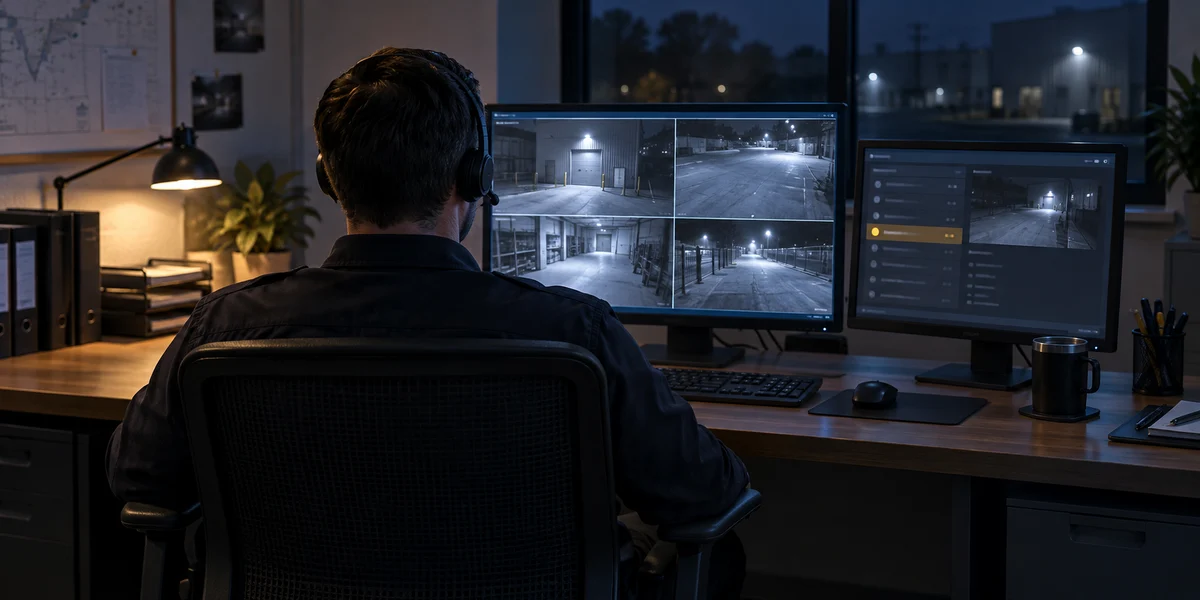
It's 2:40 AM on a Tuesday. A motion sensor in a warehouse office trips, the siren starts, and the signal reaches a monitoring station about a second later. An operator sees a single zone in alarm at a commercial address.
Most people assume what happens next is a phone call and a police car. In the City of Toronto, it is neither — not yet. On that information alone, the monitoring station cannot request a police response at all.
This isn't a monitoring company being slow, and it isn't a gap in anybody's plan. It's policy, it has been in force for years, and almost nobody who owns an alarm system has read it.
The Rule Most People Don't Know They're Living Under
On September 10, 2018, the Toronto Police Service implemented verified response. The Service defines it as “the requirement of validation that criminal activity is occurring/has taken place OR there is imminent threat to personal safety PRIOR to requesting a police response.”
Read that ordering carefully, because it is the whole point. Verification comes before the request for police — not before the cruiser arrives, and not during the drive. If nothing verifies the alarm, the request is never made.
The reasoning is in the Service's own published FAQ, and it is hard to argue with. Year after year, 97% of alarm activations reported to the TPS have been identified as false, across more than 23,000 alarm events. That is a very large number of officers driving to a very large number of buildings where nothing has happened.
The TPS also explains why it didn't simply raise the false-alarm fee instead: it had already tried that. The fee went from $83.50 to $130 in 2010, and neither the volume of alarms nor the 97% share of them that were false moved meaningfully. Pricing the problem hadn't changed the behaviour, so the requirement changed instead.
One exemption matters a great deal in practice: verified response applies to burglar alarms, not panic alarms. The TPS treats burglar, motion, door, window and glass-break activations as burglar alarms requiring verification. Panic, hold-up, duress and emergency-button activations are panic alarms, and those receive a response with no verification process required.
Four Ways to Prove It
The TPS accepts a burglar alarm as verified using one or more of the following: an audio device (real-time audio from the premises to a person listening), a video device (real-time video, same principle), multiple zone activations (separate zones reporting in sequence), or an eye witness (private security, or a person at the scene).
The fourth quietly reframes what a monitoring plan is buying. If verification can come from a person at the scene, then guard response, a keyholder who attends, or a neighbour who calls it in all clear the same bar a camera does.
And the third deserves more attention than it gets, because multiple zone activations require no cameras, no audio, and no additional hardware at all. A glass-break in the front office followed by a motion trip in the corridor is two zones telling a consistent story. That verification method is available to a modest, well-designed system, and it costs nothing beyond thinking about it at design time — enough detection points across the right sequence of spaces, and a monitoring station configured to report them as distinct zones rather than one lumped signal.
It is the least expensive thing on that list, and it is a design decision rather than a purchase.
Peel Plays It Differently — and Bills for It
Sewak Security's home market is Brampton and Mississauga, where Peel Regional Police runs a different model entirely. There is no verified-response requirement; Peel responds. But it has operated an alarm response policy since May 1, 1989, and a Cost Recovery Program since July 1, 2014, and that structure sets a different set of traps.
Under the current published policy, a false alarm costs $173 plus HST, a rate in effect since November 1, 2018 — the monitoring station is billed monthly, and that cost reaches the subscriber through the alarm company. Peel also reserves the right to suspend police response to a premises at any time, at its discretion, and reinstatement is not automatic: it requires a Reinstatement Request form from the alarm company or monitoring station confirming the underlying issues are resolved. Peel does not respond to automatic dialling systems activated by alarms at all.
And there is one provision that catches people: a cancellation after dispatch still counts as a false alarm. Peel accepts a cancellation from the monitoring station before the call is dispatched; once it has been dispatched, calling it off does not undo it.
That changes what a good monitoring procedure looks like. The window in which a keyholder can say “that's me, I set it off” is not “before police arrive.” It is before the call is dispatched — a much shorter window, and one that depends entirely on whether somebody answers the phone at 2:40 AM.
Peel's policy also lists the verification options it expects alarm companies to put in front of subscribers before a system goes live: telephoning the premises, contacting keyholders, reviewing the number and type of signals, accounting for work schedules and business hours, and audio and visual technology.
For scale on why any of this exists: in 2013, Peel received 22,763 alarm calls, of which 2% were valid. Two neighbouring services, two different mechanisms — one gates the dispatch, the other prices the mistake. Both are answers to the same underlying fact. If your property sits in Halton, York, Durham or elsewhere in the region, the right move is to check that service's own current policy rather than assume it matches either of these.
What This Changes About System Design
Once the bar is what can this system prove, a few choices stop being cosmetic.
Zones are evidence, not just labels. A system that reports “alarm at 14 Industrial Rd” has one thing to say. A system that reports a perimeter door, then an interior motion, then a second interior zone thirty seconds later is describing movement through a building. That is the difference between a signal and an account of what happened, and it is set when the system is designed and programmed.
Visual verification closes the gap fastest. On the Ajax platform we install, MotionCam detectors send a verification photo to the monitoring station within roughly nine seconds of triggering. That turns an operator's judgment call into something they can look at.
Panic devices are a different tool under a different rule. Because panic and hold-up activations are exempt from Toronto's verification requirement, where a panic device sits — and who can reach it — is a real design question for a retail counter or a reception desk, not an afterthought.
In Fairness to the Simpler System
None of this means a basic local alarm is worthless, and it would be dishonest to write the piece that way.
A siren does real work on its own. A large share of break-ins are opportunistic, and opportunists leave when a building starts making noise — an outcome that requires no monitoring station, no camera and no police dispatch, and the most common way an alarm system actually pays for itself. The verification rules govern what happens when someone doesn't leave. That is a narrower scenario, but it is also the one people buy an alarm for.
A simple system and a verified one are solving two different parts of the problem, and plenty of properties genuinely only need the first.
The Part That Isn't Technology
Peel's policy puts an obligation on alarm companies to make sure subscribers understand something easy to skip: keyholders have a responsibility to be available at the time of every alarm and to assist police if required, and keyholder information has to be kept current.
In practice this is where most systems quietly fail. Not the sensors — the contact list. The keyholder who changed their number two years ago. The manager who left. The one number on file that rings a desk phone in a building nobody is in at 2:40 AM. A system with excellent detection and a stale contact list produces exactly the outcome these policies exist to prevent: a dispatch nobody can verify, or a cancellation that arrives too late to count.
Reviewing that list costs nothing and takes ten minutes.
What to Actually Ask
If you own an alarm system in the GTA, the useful question isn't “is it monitored.” Almost every system is. The question is narrower: when this system trips at 2:40 AM, what will it be able to prove — and who will be reachable while it matters?
That has a specific answer for every system, and the answer is set long before the night it gets tested: in how the zones were laid out, whether anything produces audio or images, how the monitoring station is configured to report signals, and whether the contact list is current.
If you're not sure what your answer is, that is worth finding out on a Tuesday afternoon rather than at 2:40 AM. Book a complimentary consultation and we'll walk your existing system against the rules that actually apply where your property sits, or see how we approach alarm design and monitoring.